
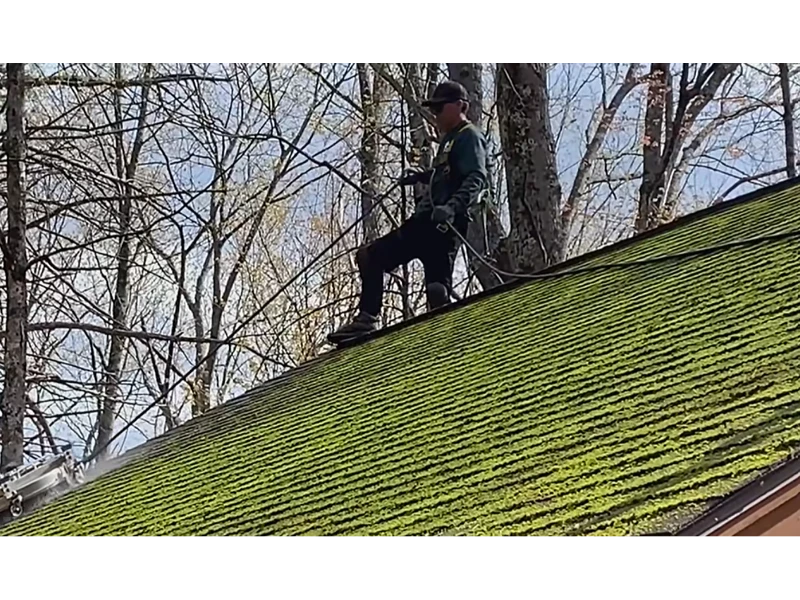
Drive through Oaklawn or any older Lafayette street and you will see the same picture. A big live oak spreads over a house, and the roof underneath it is streaked, mossy, or buried in leaves. The tree is beautiful. The roof is paying for it.
The good news is that you do not have to choose between the oak and the roof. A smart trim lets in sun and air, keeps limbs off the shingles, and leaves the tree healthy. This guide covers how live oak shade affects roofs, how much to trim, when to do it, who should do it, and how it fits with a roof cleaning.
Quick answer: Shade keeps a roof damp, and debris from the tree feeds moss. Trim so limbs do not touch the roof and more sun reaches it. Have an ISA Certified Arborist do large limbs, never top a live oak, and call Lafayette Utilities System before touching anything near a power lin
Live Oak Shading Effects on Your Roof
Shade Keeps the Roof Damp
NOAA’s 1991 to 2020 normals for Lafayette Regional Airport show about 62.8 inches of rain a year, with measurable rain on about 117 days. A roof in full sun dries fast after a storm. A roof under a live oak stays wet much longer. ARMA, the Asphalt Roofing Manufacturers Association, says algae is most widespread in warm, humid climates, and damp shaded roofs give it the best chance to spread.
Moss follows the same rule. ARMA says moss tends to grow on north facing roof planes, which get less direct sun and stay damp longer than south facing ones. Overhanging branches add more shade on top of that.
Debris Feeds Moss
Trees do not only block light. ARMA says overhanging branches drop debris that holds in moisture and acts as a food source for moss. Leaves, twigs, acorns, and Spanish moss collect in valleys and along roof edges, then hold water against the shingles.
Live oaks add a twist. The Lafayette Consolidated Government planting guide notes that live oaks drop leaves as new leaves emerge in the spring, and that they are never completely bare. So debris builds up in spring, but a little arrives all year.
Contact Wears the Roof
Roofers warn that branches rubbing shingles in the wind can wear away granules, the gritty surface that protects shingles. The same guide says live oaks often demand more room than is available, encroaching on roofs and buckling sidewalks. A limb that touches a roof in a calm breeze will touch it harder in a storm.
The Trade Off
Shade is not the enemy. The guide also notes that live oak shade is welcome in our hot summers. The goal is not a bare roof. It is a roof that can dry out and stay clear of limbs.
How Much Should You Trim?
Many roofers and arborists suggest keeping branches roughly 6 to 10 feet from the roof, and no limb should rest on shingles, gutters, or flashing. Other guides range from about 3 to 5 feet up to 10 to 15 feet. There is no single rule, and one tree service points out that a large mature oak may need a more careful plan, because removing too much live canopy at once can stress the tree.
That caution matches ISA guidance. The International Society of Arboriculture says generally no more than 25 percent of the crown should be removed at once, and less for mature trees.
For a big live oak over a roof, the practical goal looks like this:
| Goal | Method | Why |
| Stop limbs touching the roof | Selective cuts on the limbs that reach the roof | Prevents rubbing and storm damage |
| Let in more sun and air | Crown thinning, which removes a few branches throughout the canopy | Helps the roof dry |
| Clear the roofline | Crown raising, which removes lower branches over time | Opens space under the tree |
| Remove hazards | Crown cleaning, which removes dead, weak, or damaged limbs | Reduces storm risk |
All of these are selective cuts. None of them is topping.
Live Oak Pruning Rules That Protect the Tree
A roof is not worth a dead tree. These rules come from LSU AgCenter and ISA guidance.
- Follow the four D’s. LSU AgCenter says to prune mature live oaks to remove limbs that are dead, dying, diseased, or damaged.
- Never top a live oak. LSU AgCenter says topping strips most of the leaves the tree uses to make food, and the large wounds invite pests and disease.
- Match timing to the reason. LSU AgCenter says that dead wood or diseased limbs can be pruned any time of year. For live branches, it advises waiting for the dormant season, especially in heat or drought.
- Leave big limbs to professionals. LSU AgCenter guidance recommends an arborist for large broken or hanging limbs, high climbing, and overhead chainsaw work.
When to Trim in Lafayette
| Time | What to do |
| Winter, the dormant season | Best window for planned pruning of live limbs, as LSU AgCenter advises |
| Before June 1 | Inspect for dead, cracked, or hanging limbs ahead of hurricane season |
| After a storm | Look for broken and hanging limbs from the ground, and call a pro |
| Summer heat or drought | Avoid heavy live pruning unless it is a safety issue |
Hurricane season runs June 1 to November 30, according to the National Hurricane Center. LSU AgCenter guidance, as summarized by a Louisiana tree company, says to look for large dead limbs, cracks in the trunk, missing bark, and mushrooms or conks. If you see them, call an arborist before the season peaks. Our hurricane season roof guide covers the roof side of storm prep.
Power Lines, Public Property, and Local Rules
Never Trim Near Power Lines
Live oaks in Lafayette often grow wide and close to overhead lines. Lafayette Utilities System runs its own tree trimming program, using contracted crews trained for work near lines. If a limb touches or hangs near a line, keep people away and call LUS at (337) 291 5700. Do not climb or cut anything near a wire yourself.
LUS has a policy for older trees too. For legacy live oaks, LUS says it will evaluate trimming strategies with the property owner, and it is open to the opinion of a certified arborist.
Trees on Public Property
If a tree stands in a public right of way, the Lafayette Consolidated Government code says that anyone who wants to prune or remove it must first consult the government’s arborist. That includes the strip between the sidewalk and the street.
Trees on Your Lot
A 2023 report quoted a Lafayette Consolidated Government planning manager saying there was no tree protection ordinance in the city. Rules can change, so check with LCG before major work. Also look at your subdivision covenants and any HOA rules. And note that web results for “Lafayette tree protection ordinance” often point to Lafayette, California.
Trim First, Then Clean
Order matters. If you clean a roof and leave the branches, the shade and debris are still there, and growth comes back sooner. ARMA says the effect of cleaning is temporary, and that trimming branches to let in more sun is one of the steps that discourages growth.
Here is the order we suggest:
- Have an arborist trim the limbs over your roof.
- Let the crew clear the debris, or clear it from the ground.
- Schedule a gentle soft wash once the roof is clear.
- Keep your gutters clean so leaves and granules do not back up.
We clean roofs. We do not trim trees. If you need tree work, we will say so and tell you to hire an arborist. And if your roof has damage, a roofer comes before us. We explain that in when we won’t clean your roof.
How to Hire a Tree Service in Lafayette
- Ask for an ISA Certified Arborist. These arborists carry a certification number you can look up with ISA.
- Get more than one written bid and compare what each one includes.
- Ask whether the crew carries liability insurance, and ask to see proof.
- Ask how they will protect your roof while limbs come down, such as rope rigging.
- Reject anyone who suggests topping or who wants to remove most of the canopy in one visit.
- Ask about Louisiana licensing, and confirm what applies to your job.
Your Roof and Tree Walkthrough
- Walk around your house and look up at each roof slope.
- Note any limb touching the roof, gutters, or chimney.
- Look for streaks and moss on the shaded slopes, usually the north side.
- Check valleys and gutters for leaves, acorns, and Spanish moss.
- Look for dead limbs, cracks, or mushrooms on the tree.
- Take dated photos, and send them to your arborist and to us.
Frequently Asked Questions
How far should branches be from my roof?
Many roofers suggest 6 to 10 feet, with nothing touching the shingles. For a large live oak, let an arborist set the plan, so the tree is not over trimmed.
Will trimming stop black streaks?
It helps. More sun and less debris make a roof less friendly to algae and moss. But ARMA says cleaning is temporary and growth can return, and trimming does not remove stains that are already there.
Can I trim my live oak myself?
Small dead twigs from the ground are fine. LSU AgCenter says large broken or hanging limbs, climbing, and overhead chainsaw work are for professionals. Never cut near a power line
Should I cut down my live oak to protect the roof?
Usually you do not need to. Selective trimming solves most roof problems and keeps the shade. Talk to an ISA Certified Arborist before making a big decision.
Does Spanish moss hurt my roof?
It is not good for a roof when it piles up. Like leaves, it holds water against shingles. Clear it, and have it cleared from valleys and gutters.
How often should I trim?
It depends on the tree. Inspect every year, and let an arborist set the schedule for planned pruning.